

Cups vs Grams: Why Volume and Mass Aren't the Same in Baking
This article is part of our complete pillar guide: Cooking & Recipe Conversions — The Complete Guide. Head there for the full breakdown of cooking units, oven temperatures, and recipe scaling.
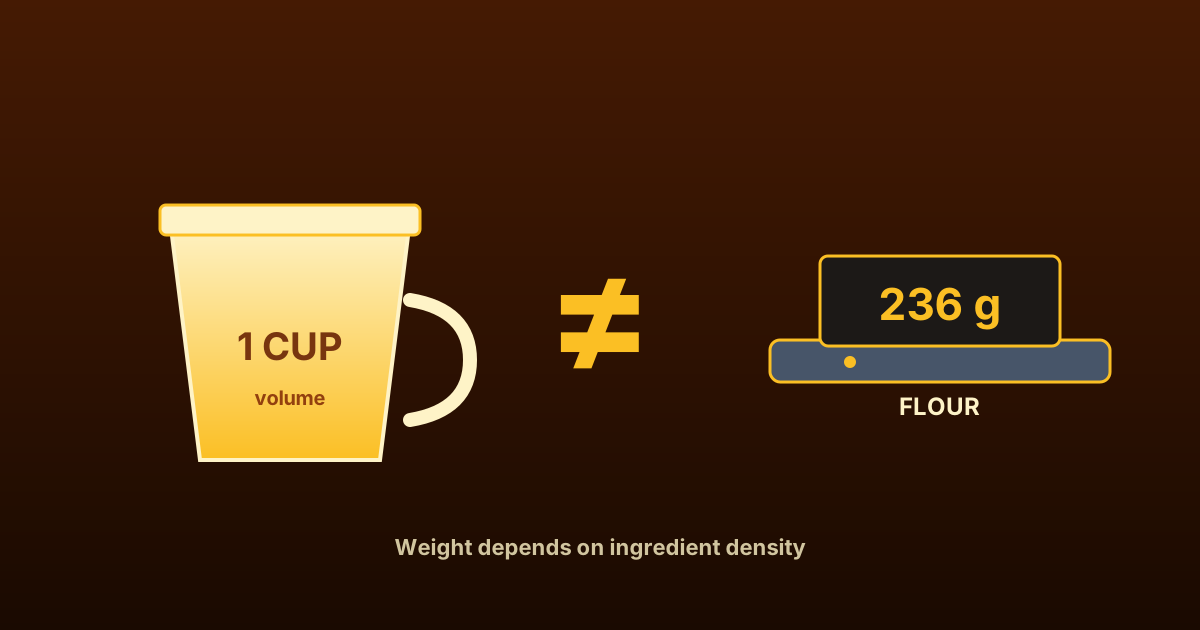
You followed the recipe exactly. One cup of flour, half a cup of sugar, two tablespoons of butter. So why did your cookies come out flat as discs while your friend's came out fluffy? The answer is almost always the same: a cup is not a unit of weight. It is a unit of volume, and in baking, weight is what your dough actually cares about.
The core problem
Here is the trap. Consider what a single "cup" weighs depending on what is in it:
| 1 cup of... | Grams |
|---|---|
| Water | 240 g |
| Granulated sugar | 200 g |
| All-purpose flour (spooned, leveled) | 120 g |
| All-purpose flour (scooped, packed) | 170 g |
| Butter | 227 g |
| Honey | 340 g |
| Cocoa powder | 100 g |
| Salt | 270 g |
One cup of flour can weigh anywhere from 120 g to 170 g depending on whether you scooped or spooned, packed it down, or sifted it first. That is a swing of over 40% from a single ingredient in a single recipe. No wonder home baking is unpredictable.
Sugar weighs almost double what flour weighs at the same volume. Honey weighs nearly three times as much. Cups treat them all as if they were the same — and they are emphatically not.
💡 Fun fact: The same brand-new measuring cup, in the hands of ten different home bakers, will produce ten different weights of flour. Studies have shown variations of up to 50% in flour measurement just from how each person scoops.
Why pros weigh ingredients
Walk into any professional bakery and you will not find a single measuring cup. The work surface has a digital scale, a tare button gets pressed, and ingredients are poured directly into the mixing bowl until the readout hits the target weight.
The reason is simple: bread, pastry, and cake recipes are formulas. The ratio of flour to liquid to fat to sugar to leavening determines the texture. A 5% variation in flour weight can be the difference between a pillowy brioche and a hockey puck. You cannot achieve 5% precision with a measuring cup.
King Arthur Baking, one of the most respected baking authorities in the United States, publishes every recipe with both volume and weight. They are open about which they consider authoritative:
"We strongly encourage you to weigh your ingredients. Volume measurements, even when done carefully, are imprecise and inconsistent."
European recipes have been weight-based for over a century. American home cooking went the volume route in the early 1900s thanks to Fannie Farmer's Boston Cooking-School Cook Book (1896), which popularized the cup as a unit of recipe measurement. Convenient for the home cook of 1896 who lacked a scale. A lasting headache for everyone since.
Common ingredients: 1 cup in grams
Bookmark this. It is the single most useful table in your kitchen.
| Ingredient | 1 cup ≈ |
|---|---|
| Water | 240 g |
| Milk | 240 g |
| All-purpose flour (spooned/leveled) | 120 g |
| Bread flour | 130 g |
| Cake flour | 115 g |
| Whole-wheat flour | 130 g |
| Granulated sugar | 200 g |
| Brown sugar (packed) | 220 g |
| Powdered (icing) sugar | 120 g |
| Butter | 227 g |
| Vegetable oil | 220 g |
| Honey | 340 g |
| Maple syrup | 322 g |
| Cocoa powder | 100 g |
| Rolled oats | 90 g |
| Cornstarch | 130 g |
| Rice (uncooked, long-grain) | 195 g |
| Rice (cooked) | 175 g |
| Almonds (whole) | 140 g |
| Walnuts (chopped) | 120 g |
| Chocolate chips | 175 g |
| Raisins | 165 g |
| Shredded coconut | 80 g |
| Yogurt | 245 g |
| Sour cream | 240 g |
| Cream cheese | 230 g |
| Grated parmesan | 100 g |
| Cooked black beans | 175 g |
| Tomato sauce | 245 g |
| Peanut butter | 270 g |
For an interactive lookup that also handles tablespoons and teaspoons, try our cooking converter. For straight weight unit math, the weight converter handles oz, lb, kg, and stones in one shot.
The international cup problem
It gets worse. The "cup" is not a standard unit — it varies by country.
| Country | 1 cup |
|---|---|
| United States (legal cup) | 240 mL |
| United States (customary cup) | 236.59 mL |
| Imperial (UK, pre-metric) | 284.13 mL |
| Australia | 250 mL |
| Japan | 200 mL |
| Latin America (taza) | 250 mL (often, but inconsistent) |
The difference between a US cup (240 mL) and an Australian cup (250 mL) is small — about 4% — but in a precise pastry recipe it is enough to be noticed. The difference between a Japanese cup (200 mL) and a UK Imperial cup (284 mL) is enormous: 42%. A recipe written in 1950s British Imperial cups, made today with US measuring cups, will be under-measured by about 18% on every ingredient.
Modern UK recipes are almost universally in grams and milliliters, mercifully. Old British cookbooks are a minefield.
💡 Fun fact: The "stick of butter" tradition — 1/2 cup, 113 g, 4 oz — is a uniquely American convention created by the Swift & Company meatpacker in 1907 to standardize butter sales. Every US butter wrapper has had cup measurements printed on it ever since.
How to weigh without a scale
If you do not have a scale yet (and you should buy one — a decent one is under $20), here are the best workarounds:
1. The spoon-and-level method for flour
Fluff the flour in its container with a fork. Spoon it gently into the measuring cup without pressing. Scrape the top flat with the back of a knife. This gets you closest to the canonical 120 g per US cup. Never plunge the cup into the bag — that compacts the flour by 30%+ and ruins recipes.
2. Use water as a proxy
Water at room temperature weighs almost exactly 1 gram per milliliter. If your recipe calls for 200 g of water, fill your measuring cup to the 200 mL line. For other liquids (milk, broth) the substitution is within 3%.
3. Buy ingredients in known weights
A standard US butter stick is 113 g. A standard egg is roughly 50 g without shell. A "large" US egg is 50-56 g. Most baking recipes assume large eggs.
4. The cup-and-table workaround
Print our table above, tape it to the inside of a kitchen cupboard, and convert as you go. It is not as accurate as a scale, but it beats blind volume measurement.
Sibling reading
For the broader story of why weight units even exist — and why a pound and a kilogram disagree — see Pounds vs Kilograms. Cooking weight measurements are the place this divide bites home cooks the hardest.
Key takeaways
- Cups measure volume; grams measure mass. They are not interchangeable across ingredients.
- 1 cup of flour ≈ 120 g (spooned/leveled), but can vary 30%+ with scoop method.
- 1 cup of sugar (200 g) weighs almost twice what 1 cup of flour weighs.
- US, UK Imperial, Australian, and Japanese cups are all different sizes — from 200 mL up to 284 mL.
- For predictable baking, weigh everything. A kitchen scale under $20 is the highest-ROI tool in any baker's kitchen.
FAQ
How many grams is 1 cup of flour?
About 120 g of all-purpose flour when spooned and leveled — the standard professional benchmark. If you scoop directly from the bag and pack it down, you can hit 160-170 g in the same cup. That difference is enough to turn cake into bread.
Is a US cup the same as a UK cup?
No. A US cup is 240 mL (legal) or 236.59 mL (customary). An old UK Imperial cup is 284 mL, about 18% larger. Modern UK recipes use grams and milliliters, so the conflict mostly only shows up in older British cookbooks.
Why are baking recipes in metric more reliable?
Because grams measure the actual amount of ingredient regardless of how compacted or fluffy it is. A 200 g of flour is 200 g whether you sift it, pack it, or pour it. 1 cup of flour is whatever you happened to scoop that day.
Can I just measure water in cups and trust it?
Yes — water is the one ingredient where volume and mass are essentially identical: 1 mL water = 1 g water (close enough). Milk, juice, and broth are within 3-5%. But the moment you switch to flour, sugar, oats, or nuts, you need a scale.