

Light-Years vs Parsecs: Which Distance Unit Astronomers Actually Use
This article is part of our complete pillar guide: Astronomy & Space Distances — The Complete Guide. Head there for the full breakdown of the AU, light-year, parsec, megaparsec, and the limits of the observable universe.
Pop-culture astronomy says "light-years." Real astronomy papers say "parsecs." If you have ever wondered why a documentary narrator confidently tells you the Andromeda galaxy is 2.5 million light-years away while the textbook in the next aisle says 778 kiloparsecs, the answer is partly historical, partly practical, and partly because Han Solo got it embarrassingly wrong in 1977. Let us untangle it.
The quick formula
Two numbers, and you will understand 90% of every cosmic distance you ever read:
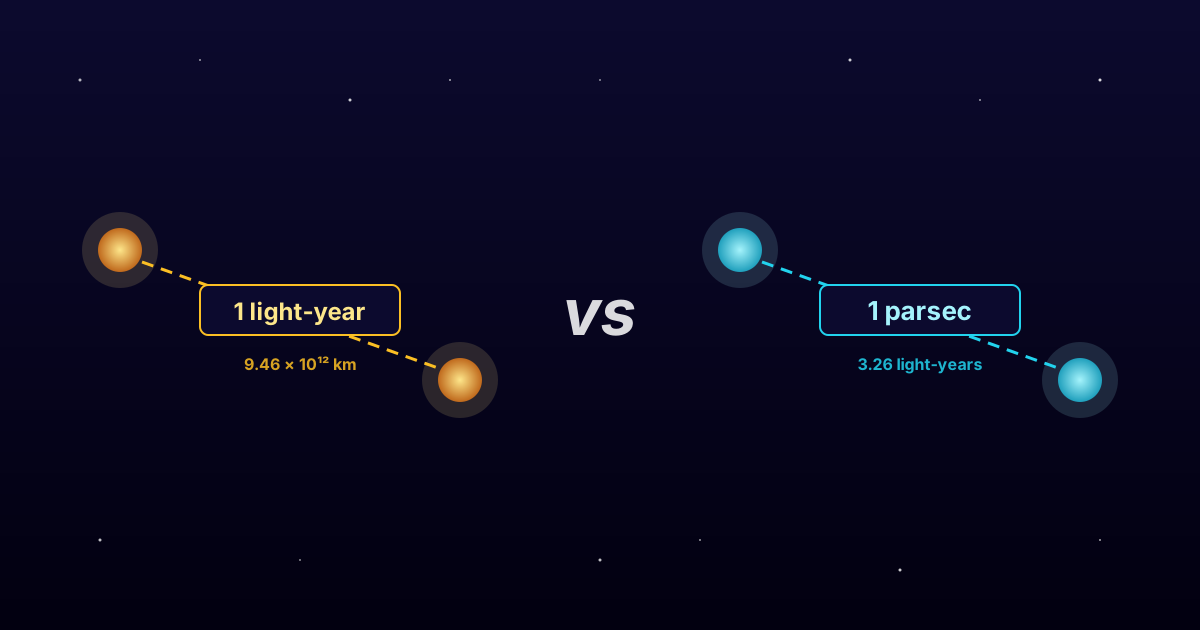
- 1 parsec = 3.2616 light-years
- 1 light-year = 0.3066 parsec
So when you hear "Andromeda is 778 kpc away," that is 2.54 million light-years. When somebody says "Proxima Centauri is 4.24 light-years away," that is 1.30 parsecs. Both numbers describe the same star at the same distance — the only thing that changes is whose convention you are using.
For instant conversion across light-year, parsec, AU, megaparsec, and other astronomical units, use our astronomical converter.
The light-year explained
A light-year (ly) is the distance a beam of light travels in one Julian year (365.25 days). Light moves at exactly 299,792,458 meters per second in a vacuum (the speed of light is now defined this way — the meter itself is defined by it).
Multiply that out:
- Seconds in a Julian year: 31,557,600
- Speed of light × seconds in a year: 9.461 × 10¹² km
That is 9.461 trillion kilometers, or roughly 5.879 trillion miles. So a light-year is a unit of distance, not time, even though it has "year" in the name. This trips up almost everyone who first encounters it.
The light-year is hugely useful in popular communication because it carries an intuitive story: "the light from this star left when Christopher Columbus landed in the Americas" or "by the time you see this supernova, the actual star has been dead for 10,000 years." That narrative is unbeatable. It is also why every science documentary uses light-years instead of parsecs.
💡 Fun fact: The light from the Sun takes 8 minutes and 20 seconds to reach Earth. The light from the next nearest star, Proxima Centauri, takes 4.24 years. If the Sun vanished right now, you would not know for over eight minutes.
The parsec — derived from parallax
A parsec is named for "parallax-second," and the definition is geometric rather than light-based. Here is how it works.
Earth orbits the Sun, so over the course of a year it occupies positions up to 2 astronomical units (AU) apart on opposite sides of its orbit. When astronomers observe a nearby star from those two positions, the star appears to shift slightly against the more distant background stars. The amount of shift is the parallax angle.
A parsec is defined as the distance at which 1 AU subtends an angle of exactly 1 arcsecond (1/3600 of a degree). Trigonometry then says:
- 1 parsec = 1 AU / tan(1 arcsec)
- 1 parsec = 3.0857 × 10¹³ km
- 1 parsec = 3.2616 light-years
The deep beauty of the parsec is that it falls out directly from the measurement technique. If you observe a star with a parallax of 0.5 arcseconds, it is 2 parsecs away. Parallax of 0.1 arcseconds, 10 parsecs away. Math done. No need to multiply by the speed of light, the length of a year, or anything else — just inversion.
Why scientists prefer parsecs
Three reasons, in order of importance:
- No dependence on the definition of "year." A light-year requires you to specify which year (Julian, sidereal, tropical?). Different conventions give slightly different answers. The parsec is a pure geometric ratio of the AU to an arcsecond, both rigorously defined SI-adjacent units.
- It maps directly to the measurement technique. For nearby stars, distance literally comes from a parallax angle in arcseconds. The parsec is whatever number you read off your instrument, inverted.
- The speed of light is a physics constant, not a length. Embedding it in a distance unit is fine for popular communication but awkward in equations where light-speed already appears in other places.
The European Space Agency's Gaia mission (2013–2025) measured parallaxes for nearly 2 billion stars and published all of its results in parsecs and milli-arcseconds. Light-years appear nowhere in the official Gaia catalogue.
💡 Fun fact: The closest star to the Sun, Proxima Centauri, has a parallax of about 0.7687 arcseconds. Take the reciprocal — 1 / 0.7687 = 1.301 parsec. That single calculation gives you the distance directly. The light-year value (4.24 ly) is just that number times 3.26.
How astronomers actually measure distances
The full toolkit, ordered by range:
| Method | Range | What it measures |
|---|---|---|
| Radar / laser ranging | Within the Solar System | Direct time-of-flight to planets, moons |
| Parallax | Up to ~10,000 parsecs (Gaia) | Geometric — apparent position shift |
| Spectroscopic parallax | ~50 kpc | Compares apparent vs intrinsic brightness |
| Cepheid variables | Up to ~30 Mpc | "Standard candle" — pulsation period gives intrinsic brightness |
| Type Ia supernovae | Up to ~Gpc | Brightest standard candles, peak at known luminosity |
| Redshift / Hubble's law | Cosmological | Expansion of space stretches light wavelengths |
The parsec was designed for the parallax method specifically. Once you graduate to standard candles and redshift, the unit no longer has any direct geometric meaning, but astronomers keep using it for consistency.
Megaparsec, kiloparsec, gigaparsec
Like every SI-style unit, the parsec scales with metric prefixes:
| Unit | Symbol | Distance |
|---|---|---|
| Parsec | pc | 3.26 ly |
| Kiloparsec | kpc | 3,260 ly |
| Megaparsec | Mpc | 3,260,000 ly |
| Gigaparsec | Gpc | 3.26 billion ly |
Within our galaxy, distances are stated in parsecs (e.g., the galactic center is ~8.2 kpc away). Distances to other galaxies are in megaparsecs (Andromeda is 0.778 Mpc; the Virgo Cluster is 16.5 Mpc). The size of the observable universe is in gigaparsecs.
The Star Wars "Kessel Run" controversy
In Star Wars (1977), Han Solo brags that the Millennium Falcon "made the Kessel Run in less than twelve parsecs." Every physics nerd in every theater simultaneously went "parsec is a unit of distance, not time" and the line became a forty-year-running joke.
Lucasfilm has spent decades retconning the line into making sense. The current canonical explanation, codified in Solo: A Star Wars Story (2018), is that the Kessel Run is a smuggling route through a gravitational maelstrom of black holes called the Maw. Pilots who can plot a tighter, more dangerous path through the Maw cover less distance — making the run in "fewer parsecs" really does signal a superior pilot.
It is a clever rescue, but the original 1977 script just got the unit wrong. George Lucas later admitted that "parsec sounded cool" and he had not realized it was a distance.
💡 Fun fact: In real astronomy, 12 parsecs is the distance to the star Vega (it is actually 7.7 parsecs — Vega is closer). The Kessel Run would have to physically span a chunk of interstellar space the size of half a constellation, not a smuggling route around a planet.
Known distances table
A pocket atlas of the universe in both units:
| Object | Parsecs | Light-years |
|---|---|---|
| The Sun | 4.85 × 10⁻⁶ pc | 1.58 × 10⁻⁵ ly (8 light-minutes) |
| Proxima Centauri | 1.30 pc | 4.24 ly |
| Alpha Centauri A/B | 1.34 pc | 4.37 ly |
| Sirius | 2.64 pc | 8.61 ly |
| Vega | 7.68 pc | 25.04 ly |
| Polaris (North Star) | 133 pc | 433 ly |
| Center of the Milky Way | 8,200 pc (8.2 kpc) | 26,700 ly |
| Large Magellanic Cloud | 50 kpc | 163,000 ly |
| Andromeda Galaxy (M31) | 778 kpc | 2,537,000 ly |
| Virgo Cluster | 16.5 Mpc | 53.8 million ly |
| Coma Cluster | 99 Mpc | 322 million ly |
| Edge of the observable universe | 14,300 Mpc (14.3 Gpc) | 46.5 billion ly |
The last row is the strange one. Although the universe is only 13.8 billion years old, the observable universe is 46.5 billion light-years in radius because space itself has been expanding while the light was in transit. Pop science articles often get this wrong by quoting "13.8 billion light-years," which is the age in years times the speed of light. Real cosmology is more subtle.
Key takeaways
- 1 parsec = 3.2616 light-years. Memorize that ratio and you can convert any astronomy headline.
- The light-year is a distance — about 9.46 trillion km — covered by light in one year.
- The parsec is the distance at which 1 AU subtends 1 arcsecond — about 3.09 × 10¹³ km.
- Astronomers prefer parsecs because they come directly out of parallax measurement and do not depend on the definition of "year."
- Galactic distances use kpc, intergalactic distances use Mpc, cosmological distances use Gpc.
- "Han Solo did the Kessel Run in 12 parsecs" was scientifically nonsensical until 2018 retconning fixed it.
FAQ
Why do astronomers use parsecs instead of light-years?
Because parsecs come directly out of the parallax measurement technique — divide 1 by the parallax in arcseconds and you get distance in parsecs. The light-year requires you to multiply by the speed of light and the length of a year, both of which are extra steps. Parsecs are also independent of the (ambiguous) definition of a year.
Is a light-year time or distance?
Distance. Despite the word "year" in the name, a light-year is the distance light travels in a year — about 9.46 trillion km. The unit is awkward but the meaning is unambiguous.
How big is the observable universe in parsecs?
About 14.3 gigaparsecs (14.3 Gpc, or 46.5 billion light-years) in radius. The total diameter is roughly 28.6 Gpc. The universe itself may be much larger or even infinite — we just cannot see past the cosmological horizon.
Was Han Solo wrong about the Kessel Run?
In 1977, yes — parsec is a distance, not a time, so "doing it in 12 parsecs" made no sense. The 2018 film Solo retroactively explained that the Kessel Run is a hazardous path that better pilots can shorten, so "fewer parsecs" really does signal a faster route. It is one of cinema's longest-running scientific cleanups.