

Miles vs Kilometers: The Complete Guide to Distance, Speed, and Why It Still Matters
This article is part of our complete pillar guide: Imperial and Metric Systems — The Complete Guide. Read the pillar for the full breakdown of every imperial-vs-metric unit category.
If you have ever rented a car in Europe, run a 5K, or tried to figure out how far Mars actually is, you have wrestled with the miles vs kilometers question. Two units, two histories, two stubborn cultures. Here is the exact math, the surprising origins, and a reference table you can bookmark for the next time a road sign confuses you.
The exact conversion (memorize this)
The formula is precise and easy:
- 1 mile = 1.609344 kilometers (exactly, by international agreement since 1959)
- 1 kilometer = 0.621371 miles
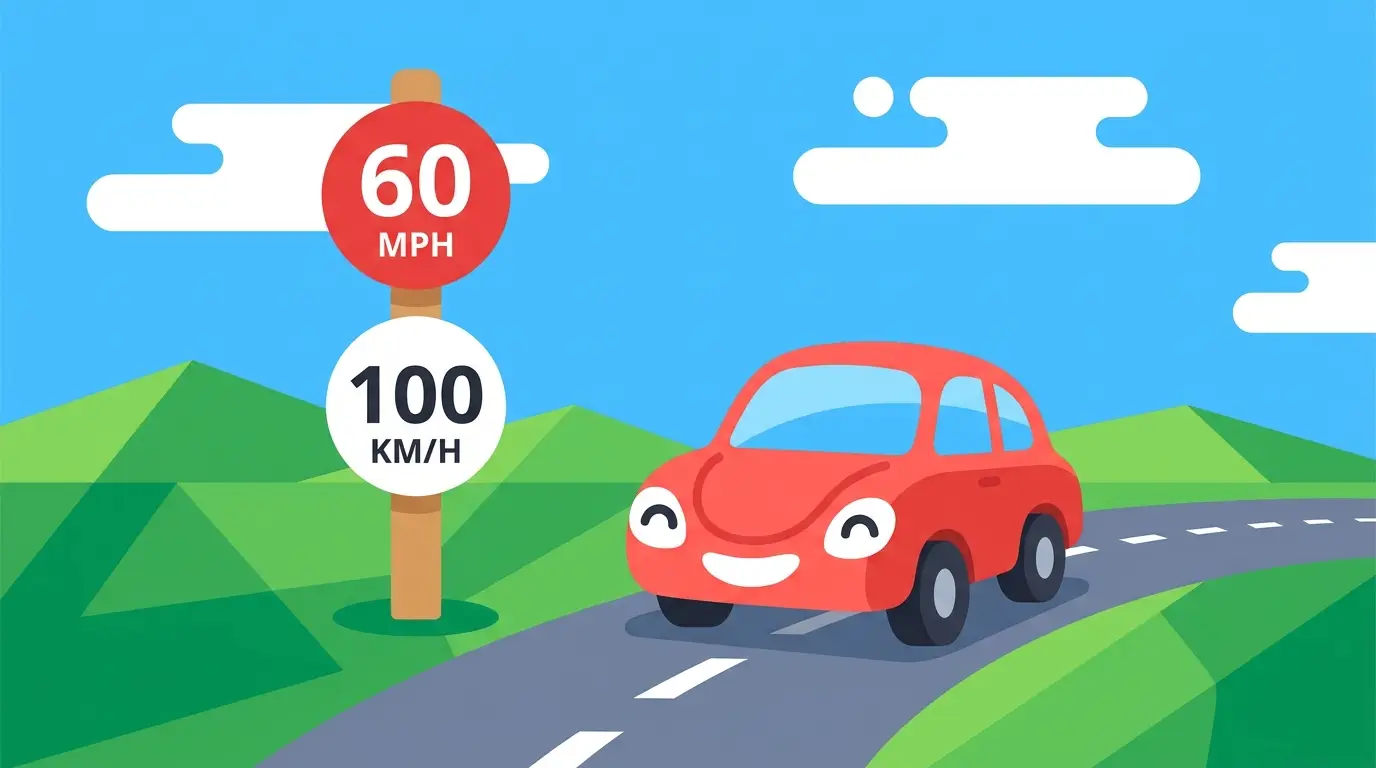
For mental math, multiply miles by 1.6 to get kilometers, or multiply kilometers by 0.6 to get miles. A 60 mph speed limit becomes roughly 96 km/h. A 100 km/h speed limit becomes about 62 mph. Need it exact? Use our mile to kilometer converter for any value.
Origin of the mile: Rome marches on
The mile is one of the oldest units of distance still in active use. It comes from the Latin mille passus — "a thousand paces" — used by the Roman army. A Roman pace was two steps (left-right), and 1,000 of them measured out roughly 1,479 meters of marching. Roman legions placed milestones along their roads to mark each mille passus, and the word "mile" descends directly from mille.
When the Roman Empire collapsed, the mile fragmented. Every kingdom in medieval Europe ended up with its own version. The English statute mile was fixed at 5,280 feet by Queen Elizabeth I in 1593. Why 5,280? It was an awkward compromise to make the mile a whole number of furlongs (an old farming unit equal to 660 feet, originally the length of a plow furrow). 8 furlongs × 660 feet = 5,280 feet. Logical at the time, baffling today.
The mile spread through the British Empire and stuck hardest in the United States, which still uses it for all road distances. Most former British colonies — Australia, Canada, New Zealand, India, South Africa — have switched to kilometers.
💡 Fun fact: A "pace" in Roman marching meant a double-step, so a Roman mile was about 1,480 meters — slightly shorter than today's statute mile.
Origin of the kilometer: a slice of the planet
The kilometer was born during the French Revolution as part of the metric system in 1795. Unlike the mile, which evolved from a human gait, the meter was defined from the Earth itself. French surveyors measured the meridian arc from Dunkirk to Barcelona and defined the meter as one ten-millionth of the distance from the equator to the North Pole along that meridian.
A kilometer is simply 1,000 meters — the "kilo-" prefix being Greek for "thousand." So a kilometer is, roughly, one ten-thousandth of the distance from the equator to either pole. That is a wildly more rational starting point than a Roman soldier's stride.
Modern definitions have since pinned the meter to physical constants (currently the distance light travels in 1/299,792,458 of a second), but the kilometer's planetary origin is still a great cocktail-party fact.
Speed limits around the world
Speed signs reveal which system a country uses. Here is a sample of urban and highway limits:
| Country | Urban limit | Highway limit | Unit |
|---|---|---|---|
| United States | 25–35 mph | 65–80 mph | mph |
| United Kingdom | 30 mph | 70 mph | mph |
| Canada | 50 km/h | 100–120 km/h | km/h |
| Australia | 50 km/h | 100–110 km/h | km/h |
| Germany | 50 km/h | unlimited on some autobahns | km/h |
| France | 50 km/h | 130 km/h | km/h |
| Japan | 40 km/h | 100 km/h | km/h |
| Brazil | 40–60 km/h | 110 km/h | km/h |
Only the United States and the United Kingdom use mph for road signs. Every other country uses km/h. If you rent a car abroad and the speedometer reads 100, double-check whether you are going 100 km/h (62 mph — fine) or 100 mph (161 km/h — license-revoking).
💡 Fun fact: Many countries set speed cameras to ignore the first 10% over the limit because tire wear, manufacturing tolerance, and odometer drift make exact speed unknowable.
Running, fitness, and the metric grip on sports
This is where it gets interesting. Most of the world is metric, but running culture is bilingual. Race distances are almost all metric, even in the United States:
- 5K = 5 km = 3.107 miles
- 10K = 10 km = 6.214 miles
- Half marathon = 21.0975 km = 13.109 miles
- Marathon = 42.195 km = 26.219 miles
Why is the marathon such an odd number? Because it commemorates the legendary 490 BC run by the Greek soldier Pheidippides from Marathon to Athens, and the modern distance was standardized at the 1908 London Olympics — set at 26 miles 385 yards (42.195 km) so the race could finish in front of the royal box at White City Stadium. That arbitrary royal decree is now the global standard.
💡 Fun fact: Before 1908, marathons were run at whatever distance the organizers felt like — the 1896, 1900, and 1904 Olympic marathons were all different lengths.
American runners track pace in "minutes per mile." European runners use "minutes per kilometer." A 6:00/mile pace equals roughly 3:44/km. Treadmills sold in the US default to mph; treadmills sold in Europe default to km/h. Same machine, different label.
Driving: crossing the US vs crossing Europe
Some context for how far these units actually scale:
- New York to Los Angeles: about 2,790 miles (4,490 km) by car. That is roughly 3 full days of nonstop driving.
- Lisbon to Moscow: about 4,330 km (2,690 miles). Comparable distance.
- London to Edinburgh: 405 miles (650 km). A long day's drive.
- Paris to Berlin: 1,050 km (650 miles). Doable in 10 hours.
If you grew up driving in the US, "300 miles" sounds like a reasonable Saturday road trip. In most European countries, "300 km" (186 miles) crosses national borders and several languages. The unit shapes how you think about distance.
Quick reference table
Bookmark this. It covers the conversions that come up 90% of the time:
| Miles | Kilometers | Context |
|---|---|---|
| 1 mi | 1.61 km | A short walk |
| 3.1 mi | 5 km | A 5K race |
| 5 mi | 8.05 km | Typical daily commute |
| 6.2 mi | 10 km | A 10K race |
| 10 mi | 16.09 km | Long bike ride |
| 13.1 mi | 21.1 km | Half marathon |
| 26.2 mi | 42.2 km | Marathon |
| 50 mi | 80.5 km | Long drive |
| 60 mph | 96.6 km/h | US suburban highway |
| 100 mi | 160.9 km | Two hours on the interstate |
| 238,855 mi | 384,400 km | Earth to Moon (average) |
Key takeaways
- 1 mile is 1.609 kilometers, exactly.
- The mile descends from the Roman "thousand paces"; the kilometer descends from a measurement of the Earth itself.
- Only the US and UK use mph; the rest of the world uses km/h.
- Running races worldwide use metric distances, even in mile-using countries.
Why both units will survive
Despite the metric system's clear logical advantages, the mile has too much cultural weight to disappear from American and British life anytime soon. Road signs, real estate listings ("five miles from downtown"), country songs, idioms ("a country mile," "go the extra mile") — all are baked in. The kilometer dominates everywhere else and will keep doing so. The realistic future is not unification but better tools for conversion.
Bottom line
Miles and kilometers measure the same thing — distance — using two different historical accidents as starting points. The kilometer is cleaner and globally dominant. The mile is older, weirder, and entrenched in two of the world's most influential English-speaking countries. Knowing the 1.6 multiplier (or having a good distance converter on your phone) is enough to navigate either world without thinking about it.
FAQ
How many kilometers are in a mile?
There are 1.609344 kilometers in one mile — an exact value defined by international agreement in 1959. For quick mental math, multiply miles by 1.6 to get a close approximation.
Why do the US and UK still use miles?
Cultural and infrastructural inertia. Replacing every road sign, speedometer, and real estate listing would cost billions, and there is no political pressure to do so. The UK officially adopted metric for most purposes in 1965 but kept miles on road signs as an exception. The US never formally committed to a metric switchover.
Is a marathon exactly 26 miles?
No — a marathon is 26 miles and 385 yards, which equals 42.195 kilometers. The exact distance was set at the 1908 London Olympics to position the finish line in front of the royal box. It became the world standard in 1921 and has not changed since.
What is 100 km/h in mph?
100 km/h equals about 62.14 mph. That is a common highway speed limit across continental Europe, Canada, and Australia — roughly equivalent to a 60 mph US limit. If you want any other value, our distance converter handles speeds and distances both ways.
More tools by Cosyslabs: Construction cost estimator · Fleet mileage tracking · Developer utilities · All Cosyslabs tools