

Horsepower vs Kilowatts: The Power Unit Showdown
This article is part of our complete pillar guide: Physics & Engineering Units — The Complete Guide. Head there for the full breakdown of power, torque, energy, pressure, and other physics units.
You're shopping for a new car. One spec sheet says "400 hp." Another says "298 kW." A third says "405 PS." All three are advertising the same engine. The world of power measurements is a mess of three competing horsepower definitions, two competing metric units, and a deep historical grudge against a Scottish steam engine salesman. Here is everything you need to actually decode an engine spec.
The quick conversion
Memorize these two numbers:
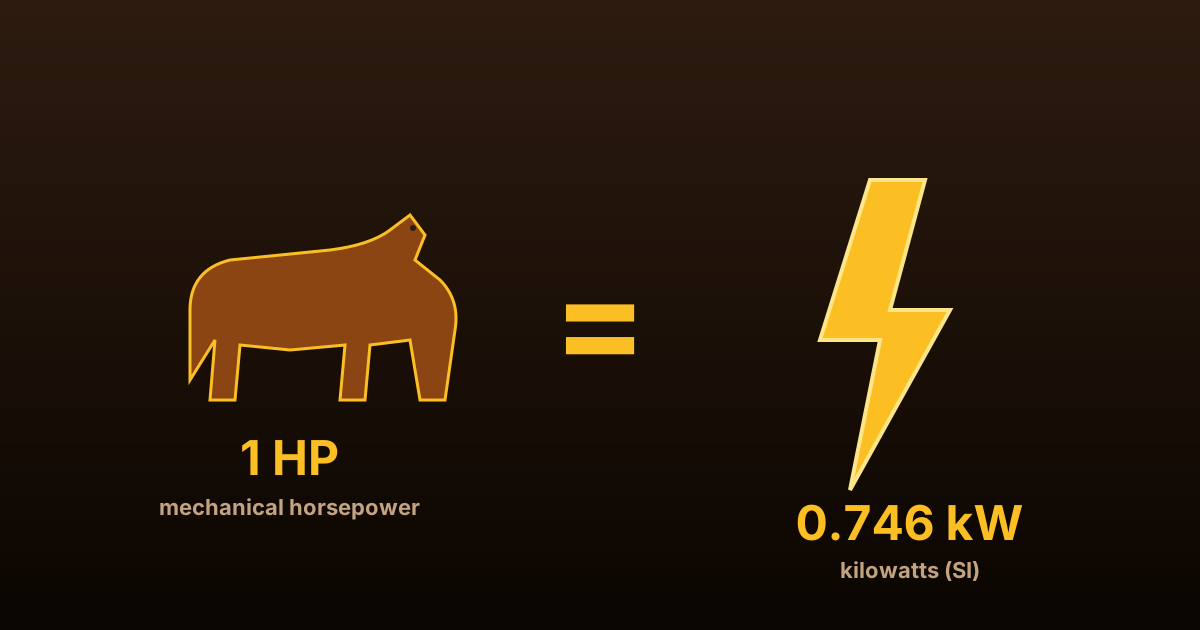
- 1 HP = 0.7457 kW
- 1 kW = 1.3410 HP
For mental math, just treat 1 HP as 3/4 of a kW. So a 400 hp engine is 300 kW. A 200 kW motor is about 270 hp. Close enough for spec-sheet skimming.
For exact figures with proper rounding, our scientific converter handles power units across mechanical HP, metric HP, kilowatts, megawatts, BTU/h, and more.
James Watt and the original definition (1782)
The story of horsepower begins with James Watt, the Scottish engineer who didn't invent the steam engine but made it commercially useful. By the 1780s, Watt was trying to sell his improved engines to British factory owners — particularly breweries, who were the heaviest industrial users of mechanical power at the time.
Breweries powered their grist mills with horses walking in circles, harnessed to a vertical capstan. Watt's sales pitch was simple: replace your horses with my engine. But how do you price a steam engine against a horse? You need a unit of comparison.
Watt timed brewery horses lifting standardized weights and arrived at his famous number: a horse could lift 33,000 foot-pounds per minute. That became 1 horsepower. He picked it generously — actual horses are closer to 0.7 HP on a sustained basis — because he wanted his engines to comfortably beat the marketing claim.
He also defined the unit in the most British way imaginable. Pounds, feet, minutes — a chimera of imperial units that survives in the US to this day. The metric world later defined "metric horsepower" using kilograms and meters, and got a slightly different number. We will come back to that.
💡 Fun fact: James Watt deliberately rounded his horsepower number upward so his steam engines would always outperform a horse. The horses he tested were strong brewery draft horses operating at their peak — most working horses produce closer to 0.5 HP sustained.
Why brewery horses?
A reasonable question. Why not racing horses, or farm plow horses, or carriage horses?
Watt's primary customer base in the 1780s was breweries — Whitbread, Bass, Guinness — and these were the industries with both the cash and the existing horse-powered infrastructure to be tempted by a steam engine. So Watt took his measurements where the customers were. Brewery dray horses are also among the strongest working horses ever bred — Shire and Clydesdale stock, deliberately selected over centuries to haul beer wagons. He picked the strongest plausible animals as his benchmark.
The result is that "1 horsepower" is roughly the maximum sustained output of an exceptional draft horse — not what an average horse can actually do. A real horse on a real workday produces about 0.5 to 0.7 HP. The unit is a marketing-friendly approximation, not a biological constant.
Mechanical vs metric vs electrical horsepower
Here is where it gets confusing. There are at least three different "horsepower" units in active use:
| Variant | Defined as | In watts |
|---|---|---|
| Mechanical (Imperial) HP | 33,000 ft·lb/min | 745.7 W |
| Metric HP (PS / CV) | 75 kgf·m/s | 735.5 W |
| Electrical HP | Defined by IEEE | 746 W |
| Boiler HP | Steam-engine specific | 9,810 W |
The difference between mechanical HP (745.7 W) and metric HP (735.5 W) is only 1.4% — but it adds up. A car advertised as "300 PS" in Germany is 295 mechanical HP, not 300. European car magazines sometimes quietly use the bigger number. A 400-HP US muscle car is 406 PS in metric — bigger number, same engine. Marketing departments love this.
Electrical horsepower (746 W) was defined to match motor nameplates and is what NEMA-rated industrial motors use in the US.
Boiler horsepower is something else entirely — a unit for rating steam boiler output, with no real relationship to engine HP except shared inheritance from Watt.
💡 Fun fact: When a German automaker advertises "405 PS" and the same car in the US is "400 HP," it is the same engine. The numbers differ because PS uses metric horsepower (735.5 W per unit), HP uses mechanical horsepower (745.7 W per unit).
HP vs PS: the European auto industry term
In continental Europe — especially Germany, France, and Italy — power is traditionally expressed in PS (German Pferdestärke, "horse strength") or CV (French cheval-vapeur, Italian cavalli vapore). These are all the same unit: metric horsepower.
| Term | Language | Definition |
|---|---|---|
| HP / BHP | English (US/UK) | Mechanical horsepower (745.7 W) |
| PS | German | Metric horsepower (735.5 W) |
| CV | French / Spanish / Italian | Metric horsepower (735.5 W) |
| CH | French alternative | Same as CV |
| HK | Scandinavian | Same as PS / CV |
| LE | Hungarian | Same as PS / CV |
| kW | Universal SI | 1000 W |
Modern EU regulations require power to be stated in kW, with PS as a permitted secondary unit. So on a German registration document you will see "Leistung: 220 kW (299 PS)." The metric system finally winning, slowly.
kW takes over in EVs
Electric vehicles have quietly killed the horsepower debate. Every Tesla, every BYD, every Polestar, every Lucid is rated primarily in kW because:
- Electric motors are spec'd in watts by convention going back a century.
- Battery capacity is measured in kWh — so motor power in kW lets you compute range and discharge time directly.
- Charging speed is also measured in kW. A "150 kW DC fast charger" delivers energy at 150 kJ/s.
- There is no engine-displacement marketing legacy (no "5.0 liter V8") for EVs to lean on.
The result is a clean energy unit ecosystem: motor power in kW, battery capacity in kWh, charge speed in kW, range in km or miles.
Most EVs still advertise horsepower on their marketing pages because spec sheets are a habit, but the actual engineering documents are all kW.
Conversion table for common car engine powers
A reference card for shopping or just decoding spec sheets:
| Vehicle / Engine | HP | kW | PS |
|---|---|---|---|
| Toyota Camry 2.5 L (2024) | 203 | 151 | 206 |
| Honda Civic Si | 200 | 149 | 203 |
| Ford F-150 (5.0 V8) | 400 | 298 | 405 |
| BMW M3 Competition | 503 | 375 | 510 |
| Porsche 911 GT3 (992) | 502 | 374 | 509 |
| Lamborghini Huracán | 631 | 471 | 640 |
| Tesla Model 3 Long Range | 449 | 335 | 455 |
| Tesla Model S Plaid | 1020 | 760 | 1034 |
| Bugatti Chiron Super Sport | 1578 | 1177 | 1600 |
| Riding lawn mower | 18 | 13.4 | 18.3 |
| Industrial wind turbine (typical) | 2680 | 2000 | 2718 |
The conversion factor never changes — every row uses the same 1 HP = 0.7457 kW relationship — but spec sheets in different countries will quote whichever number sounds better.
Sibling reading
For the broader story of why the US and Europe still measure things differently, see Miles vs Kilometers. The horsepower/kilowatt divide is essentially the same cultural phenomenon dressed up in engine bays instead of road signs.
Key takeaways
- 1 mechanical HP = 0.7457 kW. 1 kW = 1.341 HP. Use 3/4 for mental math.
- HP was invented by James Watt in 1782 to sell steam engines to breweries.
- There are three different "HP" units in active use; they differ by about 1.4%.
- PS, CV, CH, HK, and LE are all names for metric horsepower (735.5 W) used across European languages.
- EVs use kW directly because it interoperates cleanly with kWh (battery) and kW (charging).
- A car rated "300 PS" is 296 HP, not 300. A car rated "300 HP" is 304 PS.
FAQ
What is 1 horsepower in kilowatts?
1 HP = 0.7457 kW for mechanical (US/UK) horsepower. For metric horsepower (PS, CV) the figure is 0.7355 kW. The difference is small but real, and it can cost you 5–10 hp on spec sheets when crossing the Atlantic.
Why do European cars use PS instead of HP?
Because Europe formally adopted metric units, and PS (Pferdestärke) is the metric horsepower unit — defined in kilogram-force and meters rather than pound-force and feet. Under EU law, kW is now the legally required unit on registration documents, with PS allowed as a secondary label.
Why do EVs use kW for motor power?
Because electric motors have always been spec'd in watts, and using kW makes battery (kWh) and charging (kW) calculations straightforward. A 100 kWh battery on a motor pulling 100 kW will run for about an hour at full power. The math works cleanly without a horsepower detour.
How accurate is "1 horsepower equals one horse"?
Not very. Watt rounded the figure generously to make his engines look good. A real working horse sustains about 0.5 to 0.7 HP, not 1. A peak burst from an exceptional draft horse can hit 14 HP for a few seconds, but that is anaerobic and unsustainable.