

Temperature Scales: The Complete Guide
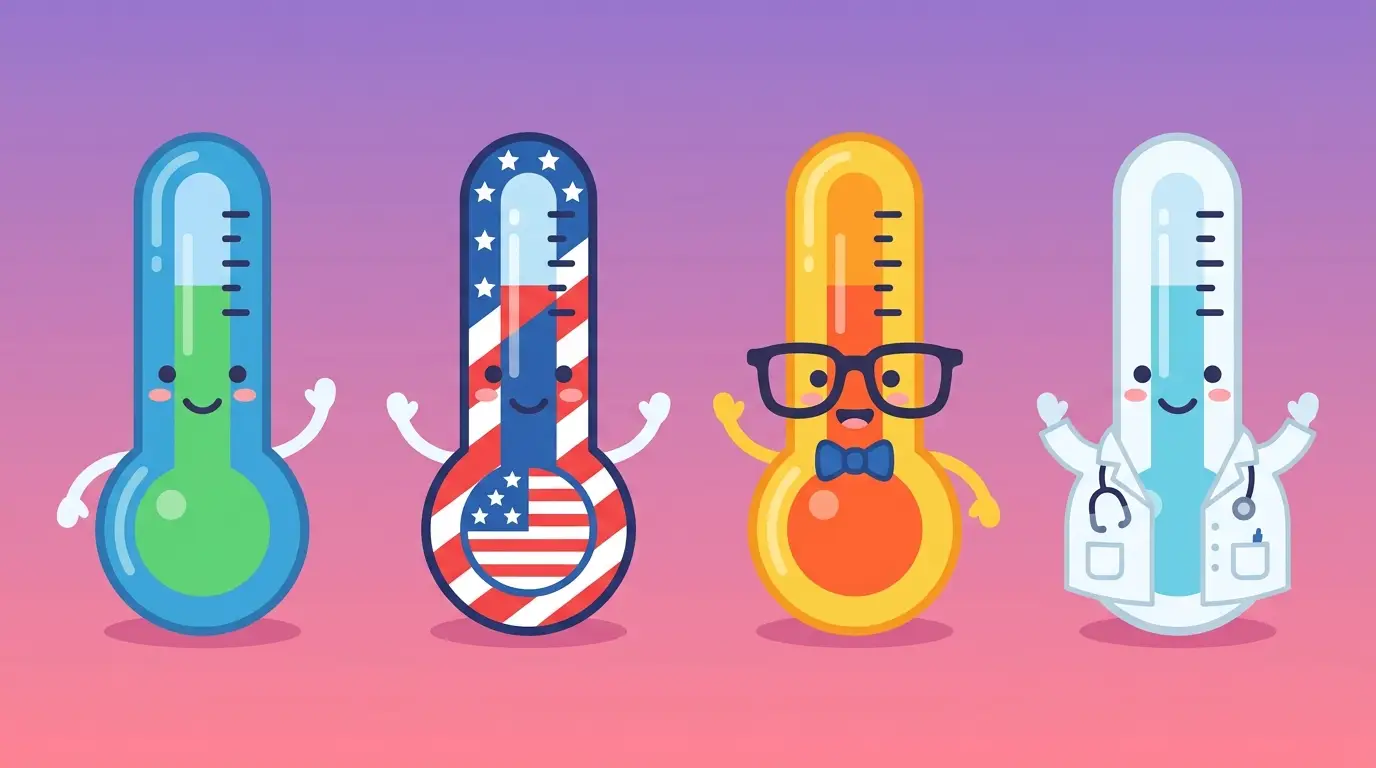
Temperature is one of the most universal quantities humans measure, yet there is no single, globally agreed-upon scale for it. Depending on where you live, what you do for a living, and what era you were schooled in, you might think in Celsius, Fahrenheit, Kelvin, or — in a few specialized engineering corners of the United States — Rankine. Each scale tells the same physical story (the average kinetic energy of particles in a substance), but each one slices that story with a different ruler.
This pillar guide walks through all four scales in depth: who invented them, where they are used, the formulas that connect them, and the everyday and scientific scenarios where each one shines. By the end, you should be able to look at any temperature in any unit and know not only how to convert it, but why the conversion looks the way it does.
If you just need a quick number, jump straight to the temperature converter — but if you want to genuinely understand the landscape of temperature measurement, read on.
Overview: The Four Common Scales
Four temperature scales dominate modern usage. Two are everyday (Celsius and Fahrenheit), one is scientific (Kelvin), and one is a niche engineering survival from the 19th century (Rankine).
| Scale | Symbol | Zero point | Boiling point of water | Primary use today |
|---|---|---|---|---|
| Celsius | °C | Freezing of water (at 1 atm) | 100 °C | Everyday use almost everywhere outside the US |
| Fahrenheit | °F | Brine freezing mixture | 212 °F | Everyday use in the US, Bahamas, Cayman Islands, Liberia |
| Kelvin | K | Absolute zero | 373.15 K | Science, especially physics and chemistry |
| Rankine | °R | Absolute zero | 671.67 °R | US thermodynamics and aerospace engineering |
Celsius and Kelvin share a degree size (1 °C change = 1 K change). Fahrenheit and Rankine likewise share a degree size with each other. The relationships between the two families are linear but offset, which is why conversions look slightly fiddly but never require anything more exotic than multiplication and addition.
Celsius (°C) — The Global Default
Celsius is named after Swedish astronomer Anders Celsius, who proposed his scale in 1742. His original version was, oddly, inverted: 0° was the boiling point of water and 100° was its freezing point. Carl Linnaeus (yes, the taxonomist) and others flipped it the right way up within a couple of years, giving us the familiar 0 °C freeze, 100 °C boil scale we use today.
Celsius is sometimes called centigrade in older texts, a name officially retired by the General Conference on Weights and Measures in 1948 to avoid clashing with the centigrade unit of angular measurement.
💡 Fun fact: The triple point of water — where ice, water, and water vapor coexist — is exactly 0.01°C / 32.018°F / 273.16 K. It's so precise it was used to define the Kelvin scale itself until 2019.
Why Celsius works so well for everyday use
- 0 °C is meaningful: it’s the point where puddles freeze and snow happens. Drivers, gardeners, and parents care about this.
- 100 °C is the boiling point at sea level — useful when cooking pasta or sterilizing equipment.
- The range from a chilly winter morning (-10 °C) to a hot summer afternoon (35 °C) maps neatly onto a 45-unit span.
- It scales perfectly with the Kelvin scale used in science (just add 273.15), making it a low-friction unit for STEM education.
Where Celsius is used
Celsius is the official everyday temperature scale in essentially every country except the United States, the Bahamas, the Cayman Islands, Palau, and Liberia. Even the UK, despite holding on to miles and pints, switched to Celsius for weather in the 1960s.
Try converting some quick reference values: 100 °C to Fahrenheit shows you the boiling point of water in the American scale (212 °F), while 37 °C to Fahrenheit gives normal human body temperature.
Fahrenheit (°F) — The American Survivor
The Fahrenheit scale was developed by Daniel Gabriel Fahrenheit, a German-Polish-Dutch physicist, around 1724. Fahrenheit was the first to make reliably accurate mercury thermometers, and he needed a scale to go with them.
His original reference points were:
- 0 °F: the coldest temperature he could reliably reproduce — a slurry of water, ice, and ammonium chloride (a chilled brine mixture).
- 32 °F: the freezing point of plain water.
- 96 °F: roughly human body temperature (later refined to 98.6 °F as thermometers improved).
The strange-looking 32–212 range for water’s freezing and boiling points isn’t arbitrary: 32 and 212 differ by exactly 180 degrees, a number rich with divisors (half-circle geometry, for one). Fahrenheit’s finer-grained degrees also meant that — in an era before decimals were comfortable — you could express small temperature differences as whole numbers more easily than in Celsius.
Where Fahrenheit lives on
The United States is by far the largest Fahrenheit-using country. The Bahamas, the Cayman Islands, and Liberia also use it informally. Several US territories use it alongside Celsius. American meteorology, cooking, HVAC, and household thermostats all default to Fahrenheit.
A useful intuition for Americans encountering Celsius: "30 is hot, 20 is nice, 10 is cool, 0 is ice." For going the other way, our Fahrenheit to Celsius converter handles the math instantly.
Kelvin (K) — The Scientific Bedrock
The Kelvin scale, proposed by William Thomson (Lord Kelvin) in 1848, is the SI base unit of temperature. Unlike Celsius and Fahrenheit, Kelvin starts at absolute zero — the theoretical point where particle motion ceases — rather than at an arbitrary, water-based reference.
Absolute zero corresponds to:
- 0 K
- −273.15 °C
- −459.67 °F
- 0 °R
A Kelvin degree is exactly the same size as a Celsius degree, so converting between them is the simplest of all temperature conversions: just add or subtract 273.15.
💡 Fun fact: William Thomson (later Lord Kelvin) calculated absolute zero in 1848 without ever reaching it. He arrived at -273.15°C purely through math, extrapolating gas behavior.
Why no degree symbol?
You write "300 K", not "300 °K". The 13th General Conference on Weights and Measures dropped the degree symbol in 1967 to emphasize that Kelvin is an absolute scale — there's no arbitrary "degree" relative to a reference point, just a count of energy units up from absolute nothingness. Strictly speaking, you also pronounce "1 K" as "one kelvin", not "one degree kelvin".
When to reach for Kelvin
Anywhere temperature appears in a physics or chemistry equation, it almost certainly needs to be in Kelvin:
- The ideal gas law (PV = nRT) — T must be in K, or pressure and volume go nonsensical.
- Blackbody radiation (Stefan-Boltzmann's T⁴ law)
- Astronomy: surface temperatures of stars are quoted in K (the Sun is ~5,778 K).
- Cryogenics: liquid nitrogen boils at 77 K, liquid helium at 4.2 K.
- Color temperature in photography and lighting (e.g. a warm white bulb is around 2700 K, daylight ~5500 K).
Try 0 °C to Kelvin to see the freezing point of water in scientific units, or absolute zero in Fahrenheit for some perspective on how cold the universe can theoretically get.
Rankine (°R) — The Engineer's Curiosity
Rankine is the Fahrenheit world's answer to Kelvin: an absolute scale that uses Fahrenheit-sized degrees. It was proposed by Scottish engineer William John Macquorn Rankine in 1859, contemporary with Kelvin's work.
The relationship is simple: °R = °F + 459.67
Rankine survives almost exclusively in US-based thermodynamics, aerospace, and certain HVAC engineering contexts — places where engineers want to do absolute-temperature calculations (which require an absolute scale like Kelvin or Rankine) without converting away from their familiar Fahrenheit-sized degrees. Outside North American engineering schools, you'll almost never see it.
💡 Fun fact: The hottest temperature ever produced by humans was 5.5 trillion degrees Celsius, created at the Large Hadron Collider in 2012 when scientists smashed lead ions together. For comparison, the Sun's core is about 15 million °C.
Conversion Formulas — A Master Reference Table
Here is every pairwise conversion among the four scales. Memorize the C↔F formula and the C↔K shift; the rest can be derived from them.
| From → To | Formula |
|---|---|
| Celsius → Fahrenheit | °F = °C × 9/5 + 32 |
| Fahrenheit → Celsius | °C = (°F − 32) × 5/9 |
| Celsius → Kelvin | K = °C + 273.15 |
| Kelvin → Celsius | °C = K − 273.15 |
| Fahrenheit → Kelvin | K = (°F − 32) × 5/9 + 273.15 |
| Kelvin → Fahrenheit | °F = (K − 273.15) × 9/5 + 32 |
| Fahrenheit → Rankine | °R = °F + 459.67 |
| Rankine → Fahrenheit | °F = °R − 459.67 |
| Celsius → Rankine | °R = (°C + 273.15) × 9/5 |
| Kelvin → Rankine | °R = K × 9/5 |
| Rankine → Kelvin | K = °R × 5/9 |
If you don't want to do the math by hand, the temperature converter handles all twelve pairs instantly.
Practical Scenarios
Weather
Most of the world checks the morning forecast in Celsius. A simple mental map: below 0 °C means ice; 10 °C is jacket weather; 20 °C is t-shirt comfortable; 30 °C is hot; 40 °C is dangerously hot. In Fahrenheit, the corresponding map is roughly 32 / 50 / 68 / 86 / 104.
Cooking and Ovens
Ovens are a special case because of gas marks, a British baking convention. Gas Mark 1 is around 275 °F (135 °C); each gas mark step is roughly 25 °F (about 14 °C). Our dedicated oven converter handles Celsius, Fahrenheit, and gas marks together so a UK cookbook works in a US kitchen.
Body Temperature
Normal human body temperature is famously 98.6 °F (37 °C), although recent studies suggest the real population average has drifted closer to 97.9 °F. A fever begins at around 100.4 °F (38 °C). Hyperthermia becomes dangerous above 40 °C (104 °F).
Scientific Lab Work
Lab work uses Celsius for everyday measurements (room temperature, incubators, heating baths) and Kelvin for anything thermodynamic. Cryogenics work measures in Kelvin almost exclusively — saying "liquid nitrogen boils at −196 °C" is correct but reads as needlessly long compared with "77 K".
Country Adoption
| Region | Everyday scale | Scientific scale |
|---|---|---|
| United States | Fahrenheit | Kelvin (science) / Rankine (engineering) |
| United Kingdom | Celsius | Kelvin |
| European Union | Celsius | Kelvin |
| Canada | Celsius (weather) / Fahrenheit (cooking informally) | Kelvin |
| Australia & New Zealand | Celsius | Kelvin |
| Japan, China, India | Celsius | Kelvin |
| Bahamas, Cayman Islands, Liberia | Fahrenheit | Kelvin |
| Latin America | Celsius | Kelvin |
The US is overwhelmingly the outlier here, though even in America scientific and medical contexts are quietly Celsius/Kelvin-dominant under the hood.
Common Sources of Confusion
"Room temperature"
In Celsius countries, room temperature is usually quoted as 20–22 °C. In Fahrenheit-using America, it's around 68–72 °F. Both numbers refer to the same comfortable indoor air; they're just labeled differently.
Normal body temperature
98.6 °F became famous as a clean-looking integer-ish number, but it’s actually the Fahrenheit conversion of 37.0 °C — a value chosen by 19th-century German physician Carl Wunderlich as a population average. Modern data suggests the actual average is slightly lower, around 36.6 °C / 97.9 °F.
Gas marks vs degrees
A British recipe calling for "Gas Mark 4" is asking for roughly 180 °C / 350 °F — standard moderate-oven territory. Don't try to convert gas marks by guessing; use the oven converter which has the lookup table built in.
Negative temperatures
Negative Celsius and Fahrenheit values are everyday — your freezer runs at around −18 °C / 0 °F. But negative Kelvin values are physically impossible (you can't go below absolute zero) outside of a few exotic quantum systems where the math allows "negative absolute temperature" as a mathematical curiosity that actually corresponds to extremely hot, not extremely cold.
FAQ
Which is bigger, a degree Celsius or a degree Fahrenheit? A degree Celsius is larger. 1 °C equals 1.8 °F. That's why Fahrenheit numbers change faster as the weather warms or cools.
At what temperature do Celsius and Fahrenheit read the same number? At −40°. Both scales cross at that single point: −40 °C = −40 °F. A handy bar-trivia fact and an actual cold winter day in parts of Canada.
Why isn't Kelvin used for weather? Because it would mean reading the forecast as "today's high is 295 K." That works mathematically but adds 273 to every number for no perceptual benefit. Celsius retains everything useful about Kelvin (degree size, scientific compatibility) without the offset.
Is Rankine still taught? Mostly only in US mechanical and aerospace engineering programs where some legacy textbooks and industry standards still default to it. New textbooks increasingly use SI (Kelvin) throughout.
Can you have a negative Kelvin temperature? Not in the everyday sense. Absolute zero (0 K) is the floor for normal thermodynamic systems. Certain exotic quantum systems can have what's mathematically labelled "negative temperature," but it corresponds to a population inversion that is hotter than any positive-temperature state, not colder.
Related guides
- Blog: Celsius vs Fahrenheit — Which Is Better, and Why? — a deeper dive into the cultural and practical reasons for the split.
- Blog: Kelvin Scale Explained — Absolute Zero, Science, and the Missing Degree Symbol — what 0 K actually means and where Kelvin shines.
- Blog: Oven Temperature Guide — Celsius, Fahrenheit, and Gas Marks — every common baking temperature converted side-by-side.
- Converter: Temperature Converter — convert any of the four scales pairwise, instantly.
- Converter: Oven Converter — adds British gas marks to the temperature picture for baking.
- Related pillar: Cooking Measurements & Recipe Conversions — oven settings, recipe scaling, and the cups-vs-grams problem.
- Related pillar: Physics & Engineering Units — temperature appears in nearly every physics formula; this guide ties Kelvin into the rest of SI.
- Quick conversions:
Whether you're a student wrestling with PV = nRT, a traveler trying to figure out what 28 °C feels like, or an engineer working in a Rankine-flavored corner of US aerospace, the four scales above cover virtually every temperature you'll ever need to handle. Bookmark this page and the temperature converter and you'll be ready for any of them.